 Allbridge
 Core routes stablecoins through compatible cross-chain protocols
Allbridge Core matches supported stablecoin transfers to the protocol available for the selected tokens and networks. USDC routes use Circle's Cross-Chain Transfer Protocol (CCTP), including CCTP V2, or xReserve for USDC-backed stablecoin routes. USDT and USDe use LayerZero's Omnichain Fungible Token (OFT) standard. Each route needs compatible configuration at both endpoints; matching tickers do not establish that compatibility. The selected messenger also determines the approval spender, fee calculation, and available gas options. The receive quote and transfer status apply to that configuration, with minimum amounts and payment choices varying by protocol.
Stablecoins and Their Transfer Standards
CCTP and CCTP V2 carry native USDC between endpoints that support the same protocol variant, while OFT connects supported USDT and USDe token deployments. The xReserve path supports USDC-backed stablecoin routes. Source and destination token entries identify the asset representation that arrives. Core's contracts prepare transfers and collect fees; the underlying protocol performs the token movement. The app selects an available mechanism for its route. A Core SDK integration chooses the messenger explicitly and supplies it to quoting, allowance checking, and sending methods. Different assets on one network can therefore have different available transfer paths.
Core's native transfer flow has no swap exchange rate or price impact. Allbridge Next combines token conversion with bridging when the destination asset needs to change.
What Makes a Stablecoin Route Compatible?
A Core route is compatible when the selected protocol's required configuration exists on both token entries, including any identifiers that must match. CCTP requires
cctpAddress
at both endpoints. CCTP V2 separately requires
cctpV2Address
on each token entry. An OFT route needs matching
oftId
values and an
oftBridgeAddress
on both chains. For xReserve, both tokens need an
xReserve
configuration. These requirements apply to the chosen messenger. The presence of one protocol's address does not establish support for another protocol.
Core's network set includes Ethereum, Polygon, Avalanche, Arbitrum, Base, Optimism, and Unichain, alongside Tron, Solana, Sui, and Stacks. Ethereum Virtual Machine (EVM) compatibility describes a network's execution environment. It does not establish that every stablecoin on that network shares a transfer standard with every destination. The SDK exposes chain and token details through
chainDetailsMap()
, including token addresses and decimals. Those token entries provide the inputs for checking the selected pair. Route availability follows their protocol configuration, so a network list cannot substitute for a compatible token pair.
Stellar support in Core is temporarily unavailable while its CCTP implementation awaits audit.
Token Listings and Route Readiness
A token that appears on both network lists can still lack a shared messenger. For a CCTP transfer, the source and destination token entries determine whether quoting and authorization can proceed.
-
Proceed with a CCTP quote when both selected token entries provide
cctpAddress. Calculate the receive amount using that same messenger. -
Stop before authorization if
getAverageTransferTimereturnsnullfor the selected messenger and pair. That response means the messenger is unavailable for that route. - Select an alternative messenger only when its endpoint requirements hold. Recalculate its quote and identify its source spender; an existing approval does not enable an unsupported route.
- Check that the recipient address fits the destination network. Complete any required approval on EVM networks or Tron before submitting the send transaction with the chosen tokens and recipient.
- Reconcile the transfer status with the recipient's balance of the selected destination token. A source transaction identifier alone does not confirm that the destination received the stablecoins.
Does Changing the Messenger Change the Approval Spender?
Changing the messenger can change the source contract that spends the tokens, so an existing approval must cover the selected protocol's spender. SDK approval handling applies to EVM networks and Tron. CCTP uses the source token's
cctpAddress
, and CCTP V2 uses its
cctpV2Address
. OFT uses the source chain's
oftBridgeAddress
, while xReserve uses the
bridgeAddress
inside its token configuration. The SDK requires the messenger when checking an allowance or building an approval.
For Ethereum USDT, the SDK approval path resets an existing nonzero allowance to zero before setting the new allowance.
This adds an approval transaction for that token's contract behavior. The
bridge.checkAllowance
method checks whether the selected spender already has enough authorization for the requested amount. Token approval and the send transaction remain distinct operations.
Route Fees and the Recipient Amount
The receive quote expresses how many destination tokens remain after the selected messenger's bridging fee, using the transfer amount and the selected token pair. CCTP and CCTP V2 apply their configured fee shares. OFT uses the fee share that Core's API supplies for the route. The SDK calculates the recipient amount through
getAmountToBeReceived
, with the messenger supplied explicitly. A new token pair or messenger changes the inputs to that calculation. Fee configuration therefore belongs to the route, and one quoted percentage cannot describe every supported transfer.
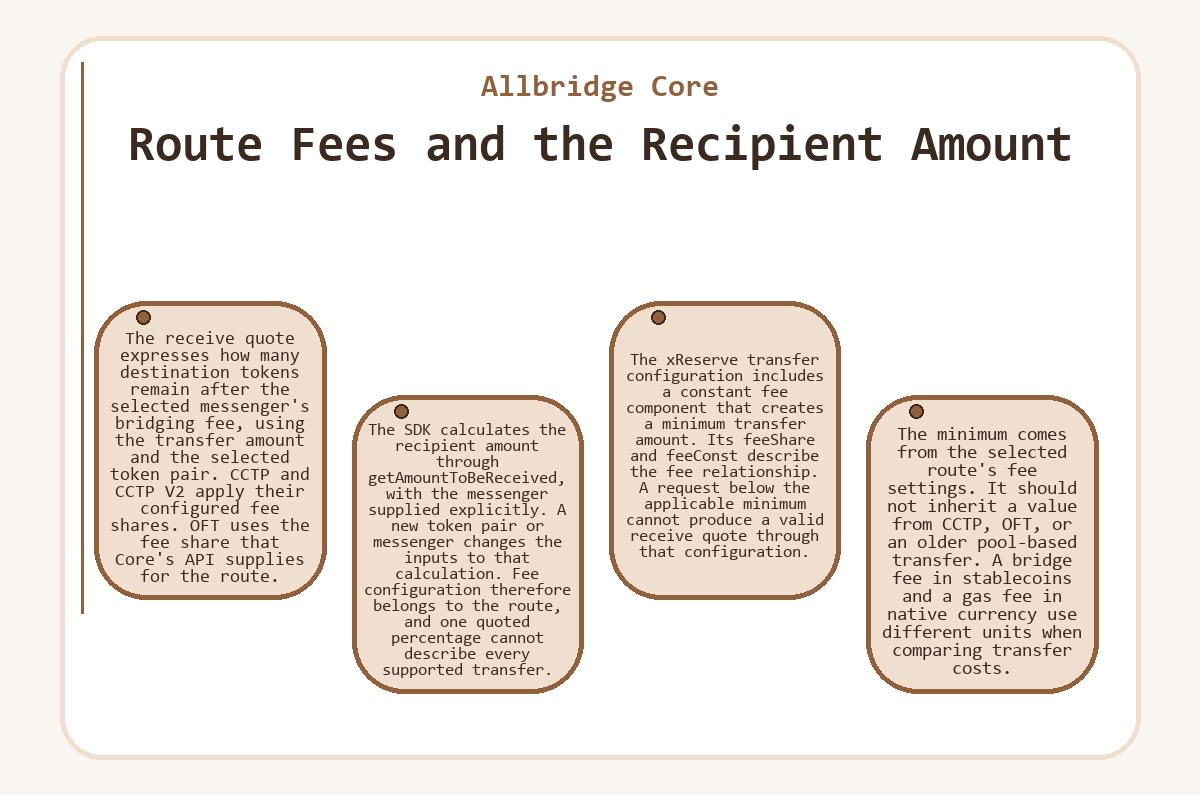
The xReserve transfer configuration includes a constant fee component that creates a minimum transfer amount.
Its
feeShare
and
feeConst
describe the fee relationship. A request below the applicable minimum cannot produce a valid receive quote through that configuration. The minimum comes from the selected route's fee settings. It should not inherit a value from CCTP, OFT, or an older pool-based transfer.
A bridge fee in stablecoins and a gas fee in native currency use different units when comparing transfer costs.
Fee Payment and Destination Gas Options
Core's interface offers gas-token, stablecoin, and discounted ABR0 fee payment where the selected route supports those choices. An SDK integration reads its available payment methods through
getGasFeeOptions
. Destination gas top-ups supply a separate native-currency amount for later transactions. They have route-specific limits, which integrations can read through
getExtraGasMaxLimits
. The xReserve messenger does not support extra gas and returns zero extra-gas limits. Its stablecoin route therefore cannot acquire a top-up merely by changing the payment token.
Transfer Records and Destination Receipt
Core's app tracks transfer progress and keeps past transfers in its history, while Core Explorer identifies transaction details such as chains and messaging protocols. SDK integrations retrieve transfer information through
getTransferStatus
, using a chain symbol and transaction identifier. A confirmed source transaction establishes activity on the sending chain. The receiving state concerns the selected destination token and recipient, so the source identifier alone cannot establish that balance.
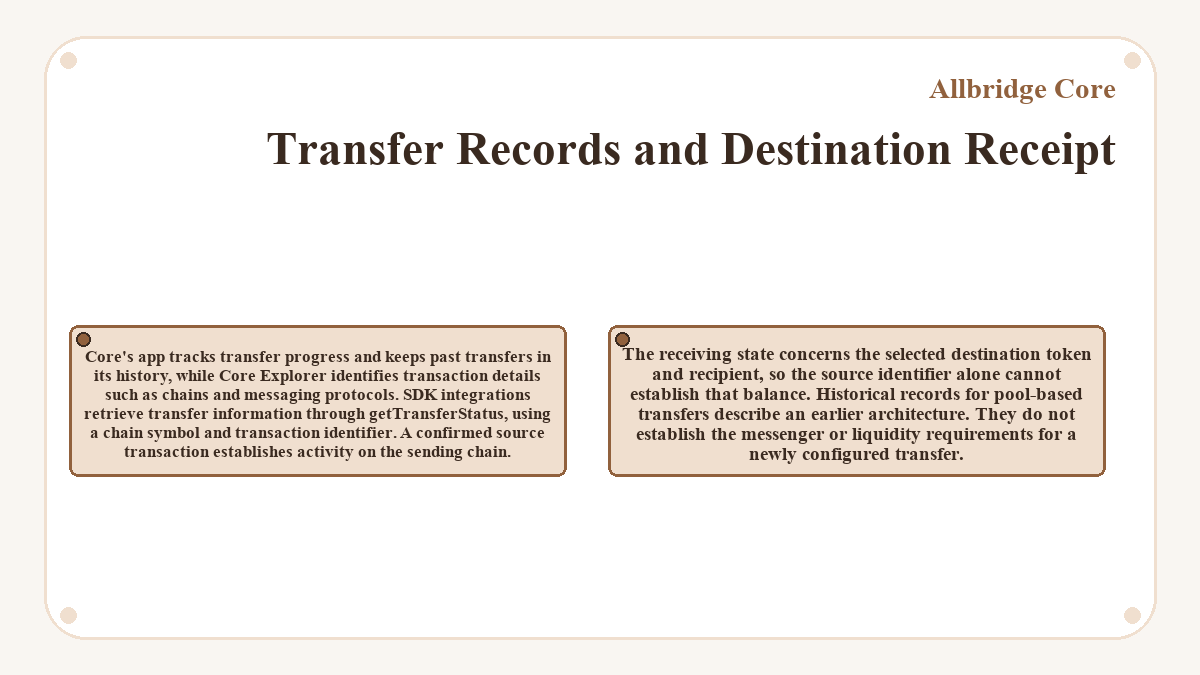
Historical records for pool-based transfers describe an earlier architecture. They do not establish the messenger or liquidity requirements for a newly configured transfer.
Pool Closure and Legacy Route Boundaries
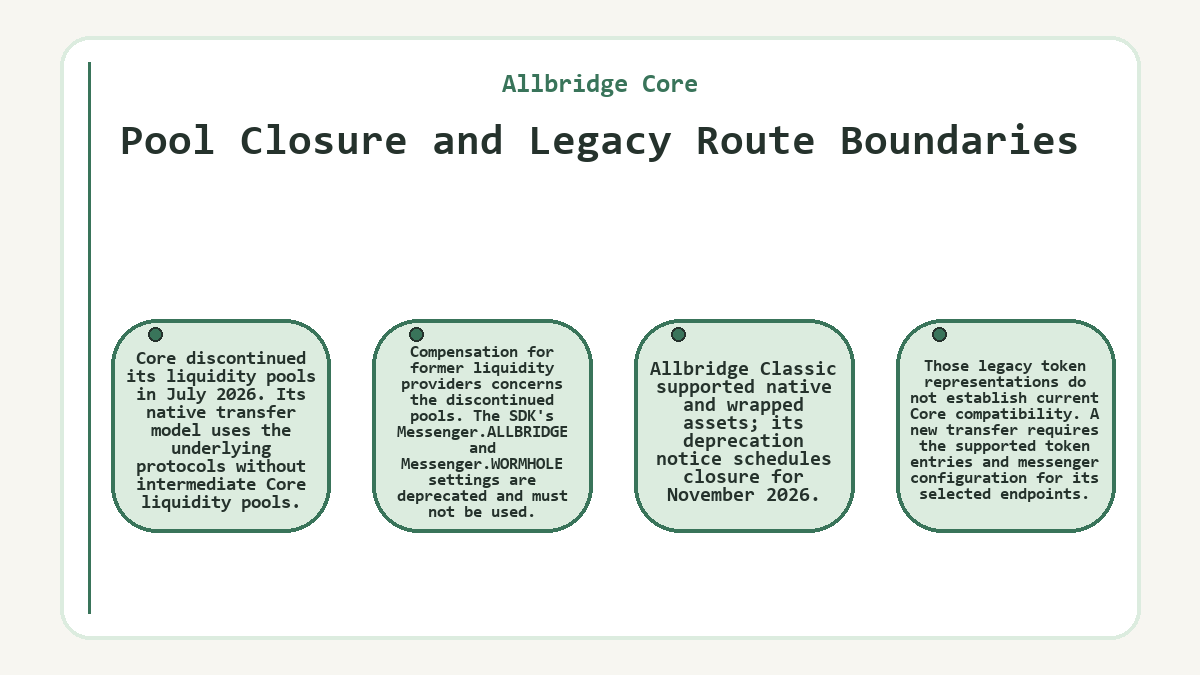
Core discontinued its liquidity pools in July 2026.
Its native transfer model uses the underlying protocols without intermediate Core liquidity pools. Compensation for former liquidity providers concerns the discontinued pools. The SDK's
Messenger.ALLBRIDGE
and
Messenger.WORMHOLE
settings are deprecated and must not be used. Allbridge Classic supported native and wrapped assets; its deprecation notice schedules closure for November 2026. Those
legacy token representations
do not establish current Core compatibility. A new transfer requires the supported token entries and messenger configuration for its selected endpoints.
Allbridge Core: frequently asked questions
How Can I Calculate the Send Amount for a Required Core Receive Amount?
The SDK's getAmountToSend calculates the source-token amount needed for a specified recipient amount after the chosen messenger's bridging fee. Supply the desired receive amount, source token, destination token, and messenger. This reverse calculation addresses the token transfer; available gas-fee payment options remain a separate part of the cost.
What Happens If an xReserve Amount Falls Below the Route Minimum?
The SDK's getAmountToBeReceived throws an SdkError that includes the applicable minimum when an xReserve amount is too low. That response rejects the amount calculation. The selected xReserve configuration determines the minimum through its fee settings, so a threshold taken from another route does not resolve the error.
Does a Raw Core SDK Transaction Mean That the Transfer Has Been Submitted?
A raw transaction from the SDK transaction builder does not establish submission to a blockchain. The builder prepares transaction data; the integration must submit it through its wallet or blockchain connection. An approval authorizes spending, while the send transaction initiates the cross-chain transfer.
What Does a Missing Stablecoin gas-fee Quote Mean in the Core SDK?
A missing stablecoin property in getGasFeeOptions means stablecoin gas-fee payment is unavailable for the selected route. When present, that property expresses the fee in units of the source token. It does not describe a destination stablecoin balance or the amount of native currency that an optional top-up delivers.
Which Currency Denominates the SDK's Native gas-fee Quote?
The SDK's native quote denominates the destination-completion fee in the source chain's native currency. Its int field uses base units, such as wei on Ethereum; float shows the corresponding token amount. This fee amount is separate from native currency that an optional destination gas top-up supplies.
Are Sender and Recipient Addresses Separate Parameters in a Core SDK Transfer?
The SDK accepts separate sender and recipient address parameters for a transfer. fromAccountAddress identifies the sender, while toAccountAddress specifies the receiving address. The selected source and destination token entries establish the networks for those roles. A correct sending address alone does not establish that the receiving address fits the destination network.
Must a Core Integration Use the SDK's Default RPC Endpoints?
A Core integration can supply its own RPC endpoints when initializing the SDK. RPC endpoints connect the integration to blockchain nodes. An integration can also initialize with defaults and pass a blockchain provider for transaction building. These connection choices leave the selected token pair's messenger requirements intact.